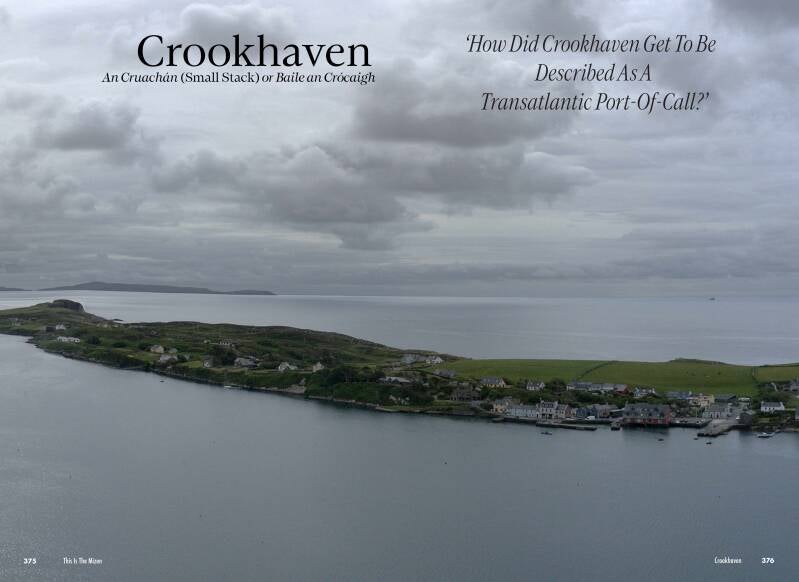
How Did Crookhaven Get To Be Described
As A Transatlantic Port-Of-Call
The tiny village of Crookhaven is at the end of the line, literally a dead end. Its tiny year round population swells hugely during the summer season with annual visitors enjoying its isolation and ready access to the sea.
Crookhaven’s origin as a settlement is unclear, however its existence is inextricably linked to the sea, its sheltered harbour was a favourite refuge and anchoring place for the foreign fishing fleets that
fished the Celtic sea over the centuries. That the O’Mahonys had tower houses on both sides of the harbour, both long gone, is a clear indication of its importance to them as a source of revenue from those fishing in the area. By the time of the Second Munster Plantation this part of the south Munster coast was singularly attractive both to English pirates fleeing King James i & iv, and to fishermen.
That tiny, isolated, impoverished Crookhaven could be a port-of-call for transatlantic liners is, of course, nonsense, as will be shown. How this myth came about is a matter of conjecture, however it almost definitely has its origins in Crookhaven’s pivotal position in Julius Reuter’s news business and the subsequent signalling activities by Lloyds of London and Guglielmo Marconi at Brow Head.
That there is not a single piece of evidence to support the claim that Crookhaven was a ‘transatlantic port-of-call’ for the transatlantic liners of the nineteenth and twentieth centuries has not hindered its dissemination as a ‘fact’ or any apparent investigation or questioning of the claim. The closest any of these liners came to Crookhaven was south of the Fastnet Rock as they sped past, east and west, obeying the shipping companies’ standing orders to so do.
If you would like to know more about Crookhaven's claim to have once been a Transatlantic port-of-call:
Create Your Own Website With Webador